
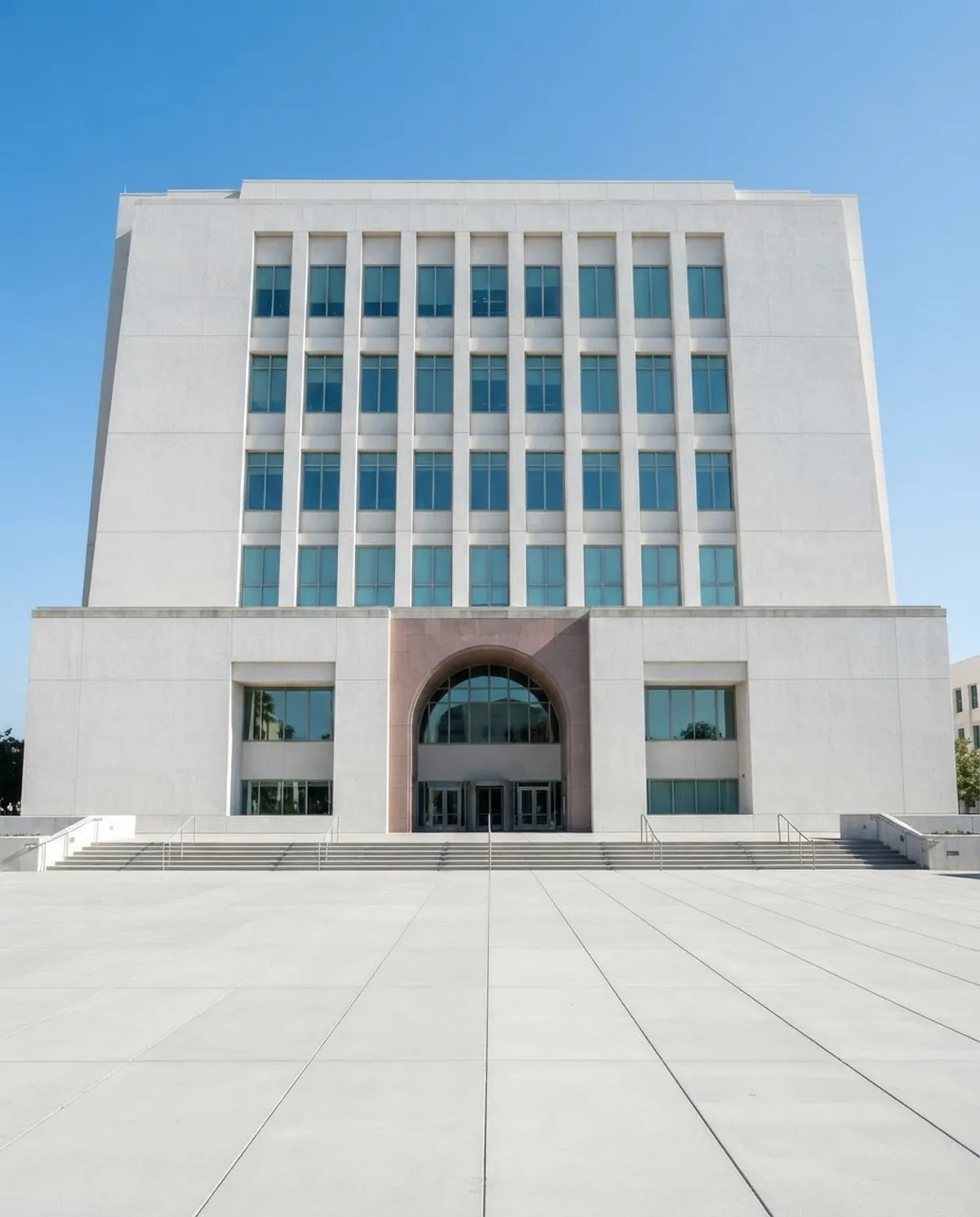
Court records of Riverside County, California, are maintained by the Clerk of the Superior Court of the county and are accessible through online tools, official court portals, and directly at the court clerk's office. RiversideCourt.us will help you find publicly available information about court cases in the county. Additional resources include the California Judicial Branch public records portal, the City of Riverside public records portal, and the court clerk's office.
Riverside Court System Overview
Riverside County is served by the Superior Court of California, County of Riverside — the state's court of general jurisdiction. California uses a unified superior court system, so there have been no separate magistrate or municipal courts in the state since 1998. At the federal level, the county is part of the Central District of California, Eastern Division.
The main courthouse of the Superior Court is located at:
The court serves over 2.4 million residents of the county and has several branches in different cities — from Indio to Murrieta. The administrative head of the court is the Presiding Judge, elected by the county's judges.
Courts Serving Riverside
Residents of Riverside County may have cases in several courts depending on the type of proceedings.
State Superior Court
U.S. District Court — Central District of California, Eastern Division
Federal Bankruptcy Court
What Types of Cases Riverside Courts Hear
The Superior Court of Riverside County hears virtually all categories of cases provided by California law:
- Criminal cases: felonies, misdemeanors, infractions
- Civil lawsuits: general civil litigation, small claims cases
- Family law: divorce, custody, support, paternity
- Probate: estates, guardianships, conservatorships, trusts
- Juvenile cases: delinquency, child protection, adoption
- Traffic violations and DUI
The federal court hears cases of federal jurisdiction — including lawsuits between residents of different states over $75,000, federal criminal cases, and bankruptcy.
District Court Cases in Riverside
In California's system, there is no separate "district court" at the state level — the Superior Court performs all trial court functions. Serious criminal cases (felonies) begin with a complaint or grand jury indictment. After a preliminary hearing, the case is assigned to a Superior Court judge for trial.
Civil lawsuits over $12,500 are handled by the general civil division. Judges are assigned according to internal court rules, often considering specialization. Appeals from Superior Court decisions are filed with the Fourth District Court of Appeal, Division Two, located in Riverside.
Magistrate Court Cases in Riverside
California abolished separate magistrate courts in 1998, merging them with superior courts. However, some functions traditionally performed by magistrates are carried out by commissioners and referees of the Superior Court.
Misdemeanors and infractions — from thefts to traffic fines — are handled by the criminal division. Small claims cases have a limit of $10,000 for individuals ($5,000 for entities). Limited civil cases cover claims up to $25,000. Preliminary hearings in felony and DUI arrest cases also start here before moving to judges of unlimited jurisdiction.
Family Law, Probate, and Juvenile Matters in Riverside
Family Law
Divorce, child custody, support, protective orders, and paternity are handled by the family law division of the Superior Court. Divorce cases are filed in the same court; the California Department of Public Health only maintains a divorce index for 1962–1984.
Probate
Probate cases, adult conservatorships, minor guardianships, and trust disputes are handled by the probate division of the Superior Court. These proceedings are generally open to the public, although some documents regarding minors may be restricted.
Juvenile Matters
Juvenile delinquency and dependency cases are heard in the juvenile justice division. Juvenile records are confidential under California law (Welfare and Institutions Code § 827). The county's juvenile court operates in a separate facility:
How Cases Move Through the Riverside Court System
- Case Filing. A criminal case begins with a prosecutor's complaint or a grand jury indictment. A civil lawsuit starts with the filing of a complaint and payment of a fee. Family and probate cases begin with the filing of a petition.
- Judge Assignment. The court clerk assigns a case number and distributes it among judges according to internal rules.
- First Hearing. In criminal cases, this is the arraignment. In civil cases, it's the Case Management Conference.
- Pretrial Phase. Parties exchange evidence (discovery) and file motions. In criminal cases, plea bargaining may occur.
- Trial or Resolution. The case ends with a court judgment, jury verdict, settlement, or guilty plea.
- Post-Judgment. The convicted person is sentenced. In civil cases, the judgment is enforced. Any party may appeal to the Fourth District Court of Appeal.
Court Administration, Local Rules, and Public Access in Riverside
The administration of the Superior Court of the county is carried out by the Presiding Judge together with the Court Executive Officer. The local rules of the Riverside County court are available on the court's official website.
According to the California Constitution and Judicial Council rules (California Rules of Court, Rule 2.503), most court records are public. Exceptions apply to juvenile cases, sealed records, certain family cases, and information protected by privacy law. The California Judicial Branch public records page explains the procedure for requesting copies.
Hearings are usually open to the public. Some proceedings are available remotely via video conference — check availability with the specific court department office at (951) 777-3147.
For city documents (non-court), use the City of Riverside public records portal.
Court Records and Related Court Resources in Riverside
- Case Search. The Riverside County Superior Court provides online access to case information through its portal on the court's website. RiversideCourt.us also allows you to find publicly available information about county court records.
- Hearing Calendar. The schedule of hearings is available on the Riverside County Superior Court website by case number or party name.
- Forms and Self-Help Resources. The court has a Self-Help Center that assists with document preparation for family, civil, and small claims cases.
- Court Clerk's Office. Requests for copies of court records are submitted in person or by mail to the clerk's office at 4050 Main Street, Riverside. Fees apply for certified copies.
- State Inmate Search. California Incarcerated Records & Information Search (CIRIS) by the California Department of Corrections and Rehabilitation allows you to find individuals in state prisons.
- County Inmate Search. Inmate Information is available on the Riverside County Sheriff's Office website.
- California Sex Offender Registry. The Megan's Law registry is available on the California Department of Justice website.
- Police Reports. To obtain police reports within the City of Riverside, contact the Riverside Police Department at (951) 354-2007.